
Your car already has power hiding inside it. The right tune simply unlocks it.
A lot of Florida drivers hear terms like ECU tuning and TCU tuning and assume they mean the same thing. They don’t. Each one changes a different part of how your vehicle performs, feels, and responds on the road.
If you’ve been searching for a real-world explanation without all the confusing tech talk, you’re in the right place.
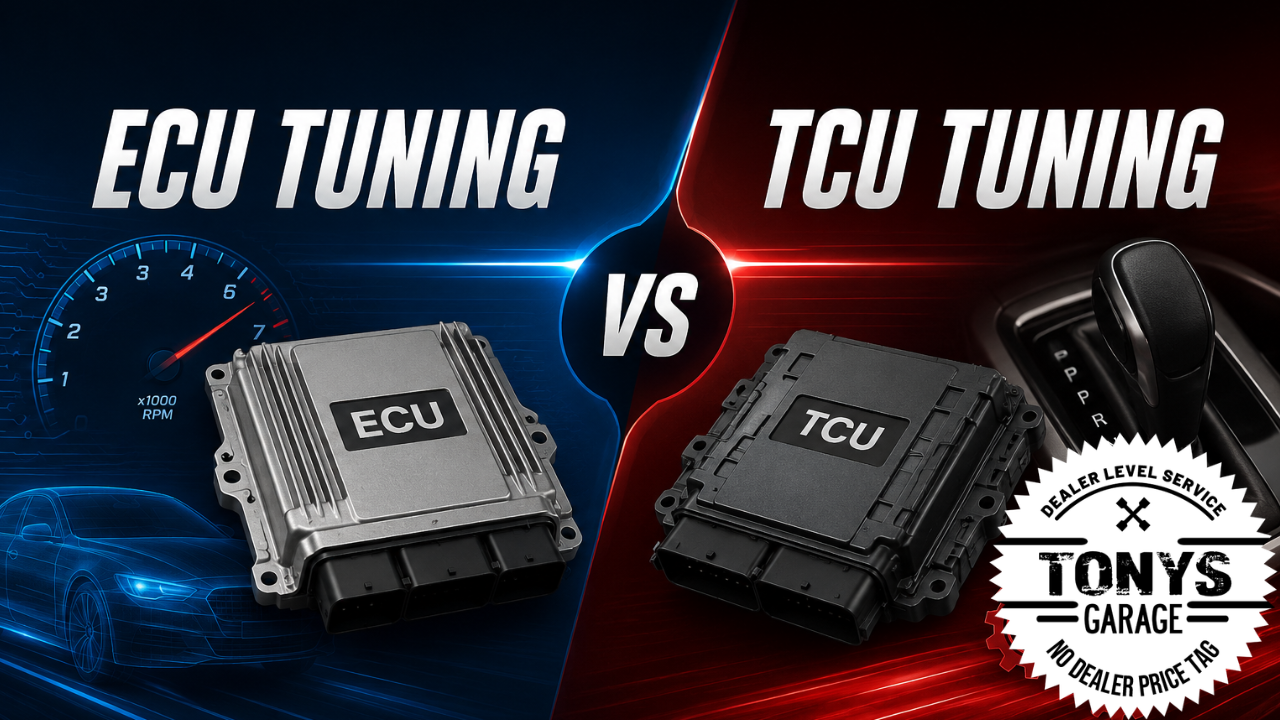
ECU tuning focuses on the engine and overall performance.
The ECU, or Engine Control Unit, works like the brain of your engine. It controls fuel delivery, ignition timing, boost pressure, throttle response, and several other performance settings.
When drivers talk about increasing horsepower or sharpening acceleration, ECU tuning is usually the reason. A good tune can make your vehicle feel quicker, smoother, and more responsive almost immediately.
That’s why the topic of ECU vs TCU tune comes up so often among performance enthusiasts. People want to know which upgrade creates the biggest difference behind the wheel.
In many cases, ECU tuning is the first step.
Florida drivers especially enjoy it because highway driving, warm weather, and long road trips make smoother performance easy to notice. Your car simply feels more alive.
A solid car tuning guide will usually recommend ECU upgrades first for drivers focused on engine output and throttle response.
TCU tuning changes how the transmission behaves.
Now let’s talk about the other half of the equation.
The TCU, or Transmission Control Unit, manages how your transmission shifts through gears. It controls shift timing, firmness, torque limits, and overall transmission behavior during acceleration.
That’s where transmission tuning comes into play.
Without proper tuning, some vehicles shift too early, hesitate between gears, or feel sluggish under hard acceleration. A TCU tune helps correct those issues and gives the transmission a more aggressive, responsive feel.
You’ll notice quicker shifts almost immediately. Some drivers also experience smoother downshifts and better power delivery during highway passing.
This matters more than people think. Even a powerful engine can feel lazy if the transmission isn’t responding correctly.
That’s why many performance shops discuss ECU vs TCU tune together instead of separately. The two systems work side by side every time you drive.
ECU tuning adds power. TCU tuning controls how that power reaches the road.
Here’s the simplest way to think about it.
ECU tuning creates performance gains. TCU tuning helps your vehicle use those gains efficiently.
Imagine upgrading your engine without improving shift behavior. The extra power may feel inconsistent or delayed during acceleration. That’s where automatic transmission tuning makes a huge difference.
The transmission learns how to handle added torque better. Shifts become cleaner. Power delivery feels more controlled.
Honestly, once drivers experience both upgrades together, it’s hard to go back to stock settings.
Florida drivers who spend time on highways or performance roads usually notice the difference quickly. The vehicle feels tighter and more connected during acceleration.
And trust me, smoother shifting makes daily driving more enjoyable too.
Some vehicles benefit more from combined tuning.
Not every car responds exactly the same way.
Turbocharged vehicles often gain major improvements from ECU tuning because the software can safely increase boost and optimize engine performance. But newer automatic transmissions also rely heavily on electronic controls.
That means automatic transmission tuning has become increasingly important in modern vehicles.
A transmission that shifts too softly can reduce the excitement drivers expect after performance upgrades. On the other hand, proper tuning creates faster gear changes and stronger acceleration throughout the RPM range.
This is why experienced tuners usually recommend pairing both systems together whenever possible.
The ECU vs TCU tune debate really comes down to driver goals. Some people want raw horsepower. Others care more about sharper shifting and smoother drivability.
Most enthusiasts eventually choose both.
Tuning can also improve the driving experience, not just speed.
A lot of people assume tuning is only for racing or aggressive driving. That’s not always true.
Some tunes improve fuel efficiency during highway driving. Others smooth out rough factory shift points or improve throttle lag in traffic. Daily commuters often appreciate those upgrades just as much as performance drivers.
A reliable car tuning guide should always explain both the fun side and the practical side of tuning.
For example, Florida traffic can feel frustrating when your vehicle hesitates constantly during stop-and-go driving. A quality tune can make acceleration feel more predictable and smoother around town.
Small improvements add quickly during daily driving.
And honestly, modern vehicles are already controlled by software. Tuning simply optimizes the settings for a better experience behind the wheel.
Choosing the right tuner matters a lot.
This part is huge.
A poor-quality tune can create transmission stress, rough shifting, or long-term reliability issues. That’s why professional shops matter so much when discussing transmission tuning and engine performance upgrades.
Experienced tuners understand how your specific vehicle responds under real-world conditions. They know how Florida heat, humidity, and driving habits affect performance tuning too.
Cookie-cutter software doesn’t always deliver the best results. Custom tuning often creates smoother performance and safer power gains.
Before choosing any tune, ask questions. Make sure the shop explains the process clearly and understands your driving goals.
Some drivers want a comfortable daily cruiser. Others want aggressive acceleration and faster shift response. Good tuning should match the way you actually drive.
ECU and TCU tuning work best together.
At the end of the day, both systems support each other.
ECU tuning improves engine behavior and performance output. TCU tuning helps the transmission respond properly to those changes. Together, they create a smoother, faster, and more exciting driving experience.
That’s why the ECU vs TCU tune conversation usually ends with the same answer from experienced drivers. Both upgrades matter if you want the best overall performance.
And once your vehicle feels sharper, quicker, and more responsive on Florida roads, you’ll understand why tuning has become so popular lately.
Frequently Asked Questions
- What is the difference between ECU and TCU tuning?
ECU tuning adjusts engine performance settings, while TCU tuning changes transmission behavior like shift timing and responsiveness. - Does ECU tuning increase horsepower?
Yes, ECU tuning can improve horsepower, torque, throttle response, and overall engine performance depending on the vehicle. - What does automatic transmission tuning improve?
Automatic transmission tuning improves shift speed, gear response, torque management, and driving smoothness during acceleration. - Should I get ECU tuning or TCU tuning first?
Many drivers start with ECU tuning for performance gains. However, combining both often creates the best overall driving experience. - Is tuning safe for daily driving?
Professional tuning is generally safe when done correctly. A quality tune should improve drivability without sacrificing reliability.