
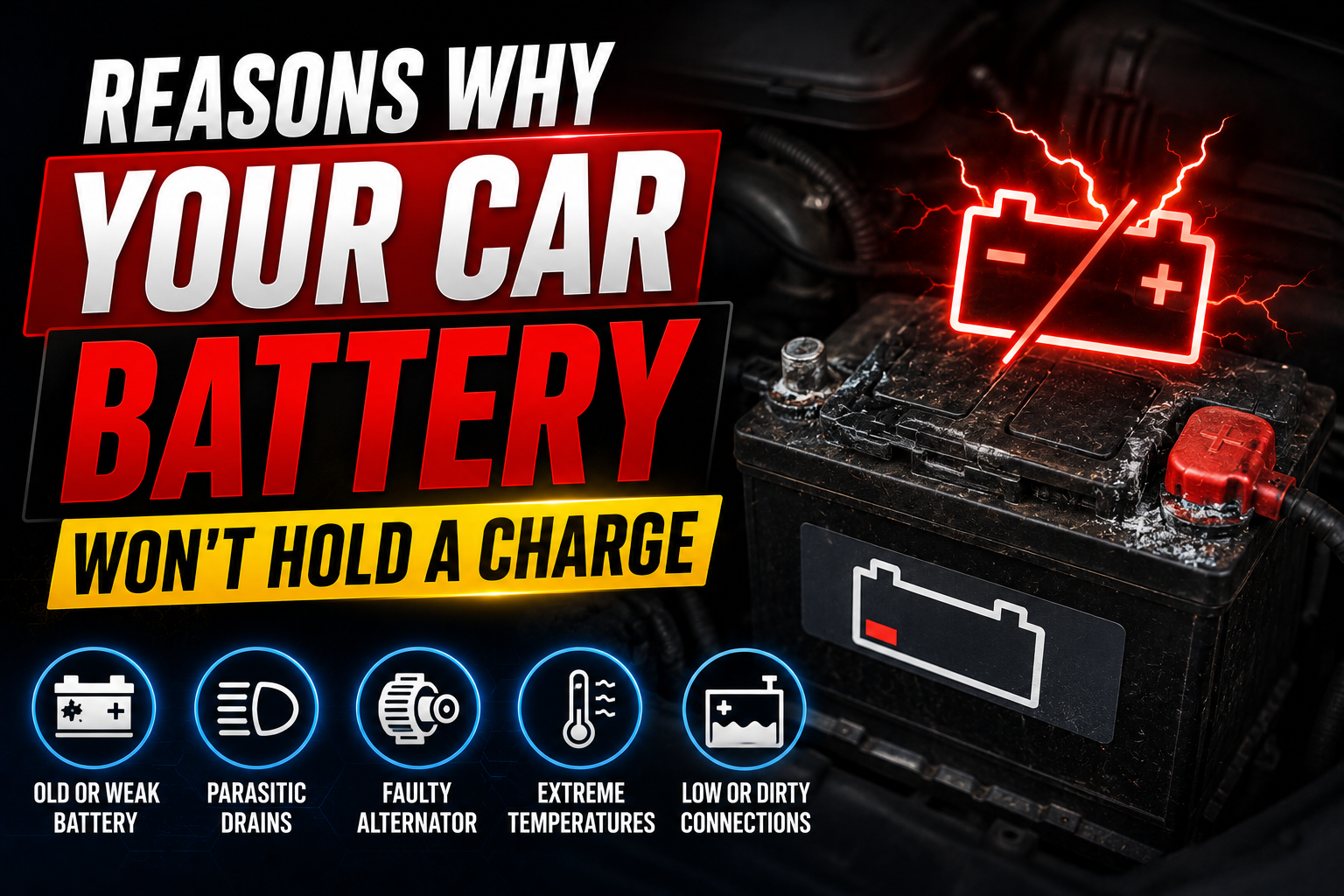
You Turn the Key and Nothing Happens. Sound Familiar?
There’s nothing quite like that sinking feeling when you’re late for work; you get in the car, turn off the key, and just hear a click. Or worse silence. Dead car battery. Again.
If it keeps happening even after a jump starts, something is wrong. Not just bad luck. An actual problem that needs to be figured out.
Florida doesn’t help things either. The heat down here is genuinely hard on batteries. Most people don’t realize that. They think cold weather kills batteries, and it does, but sustained heat wears them down just as fast, sometimes faster. We see it constantly here in New Port Richey.
Let’s go through what’s actually behind it.
Battery Deterioration It Happens to Every Battery Eventually
Nothing lasts forever, and your car’s battery is no exception. Battery deterioration is just a natural part of owning a vehicle. Over time the internal cells break down, and the battery simply can’t hold a full charge anymore no matter how long you leave it on a charger.
Most batteries last somewhere between three and five years. In Florida heat, sometimes less. If yours is pushing four years old and you’re having trouble, age is the first thing we look at.
The truth is when a battery has deteriorated past a certain point, no amount of charging fixes it. You’re just delaying the inevitable. We can test it in a few minutes and tell you exactly where it stands.
Your Driving Habit Might Be Working Against You
This one surprise people. Short trips running to the store, quick school pickups, ten minutes here and there are actually hard on a car battery. Every time you start the engine, the battery uses a big chunk of power. The alternator is supposed to recharge it while you drive. But if you’re only driving for five or ten minutes at a time, it never gets a full recharge.
That driving habit, repeated day after day, slowly drains the battery over time. Eventually it gets too weak to start the car.
We see this a lot with people who work close to home or use a second vehicle occasionally. The car sits, gets used briefly, sits again. The battery never fully recovers. If that sounds like your situation, it’s worth knowing it’s not the battery’s fault. It just needs longer runs more regularly.
Connection Issues Are Easy to Miss but Cause Real Problems
Your battery connects to the vehicle through terminals with positive and negative posts with cables attached. When those connections get corroded, loose, or dirty, the power flow gets interrupted. Connection issues are one of those things that look minor but cause major headaches.
A corroded terminal can prevent the battery from charging properly even when the alternator is doing its job perfectly. It can also cause intermittent starting problems that are hard to pin down work one day, won’t start the next.
We check every time someone comes in with a battery complaint. Sometimes it’s that simple. A good cleaning and a proper retorque on the terminals and the problem is gone. Other times it points to something deeper. Either way, you need to rule it out first.
The Charging System May Be the Real Problem
Here’s something worth understanding. Your car battery doesn’t recharge itself. It depends on the alternator to do that while the engine is running. When the charging system starts to fail whether it’s the alternator, the voltage regulator, or the wiring between them, the battery never gets properly topped off.
You might jump to start the car and drive it for twenty minutes thinking it’s fine. Then the next morning, dead again. People assume the battery is bad. Sometimes it is. But sometimes the battery is actually fine, and the charging system is just not doing its job.
We’ve replaced more than a few batteries over the years that didn’t actually need replacing, because the real issue was a weak alternator. That’s why we test the whole system, not just the battery in isolation. It saves people money and it saves them from coming back in two weeks with the same problem.
Sometimes You Just Need a Car Battery Replacement
Look, sometimes it’s straightforward. The battery is old, it’s worn out, and car battery replacement is just the right call. No mystery, no complicated diagnosis; it’s just time for a new one.
What matters is getting the right battery for your vehicle. Size, cold cranking amps, reserve capacity for these things to matter, and they vary by make and model. Putting in the wrong spec battery might get you going for a while, but it can cause problems with the electrical system down the road.
We stock quality batteries and we make sure you’re getting the right fit for your car. Not just whatever’s on the shelf.
We’re Here When You’re Ready
A battery that won’t hold a charge is one of those things that escalate fast. One morning it was slow to start. A week later you’re stranded in a parking lot somewhere.
At Tonys Garage in Port Richey, we test batteries, alternators, and the full charging system not just the easy part. We’ll tell you what’s actually wrong and what it actually costs to fix. No inflated estimates, no unnecessary replacements.
Two decades of doing this right. That’s what you’re getting when you come to see us.
Frequently Asked Questions
- How do I know if it’s the battery or the alternator causing the problem?
Honestly, the symptoms can look almost identical to dead battery, slow starts, electrical issues. The way to tell them apart is testing, not guessing. A quick alternator output test and a battery load test together give you a clear picture of which one is failing. We run both as a matter of routine when someone comes in with charging complaints. Don’t let a shop replace your battery without checking the alternator first. If the alternator is the real problem, you’ll be back with a dead battery again in no time. - Can extreme Florida heat really damage my car battery?
Absolutely. Heat accelerates battery deterioration by breaking down the internal chemistry faster than normal. Cold weather gets all the attention because batteries struggle to deliver power in the cold, but sustained heat is what actually shortens their lifespan. Here in Florida, we regularly see batteries that should’ve lasted five years to give out at three. If your battery is more than two and a half years old and you’re having any issues at all, it’s worth getting it tested. Don’t wait for it to fail completely. - My battery died but jump starting it works fine. Do I still need to replace it?
Maybe, but not necessarily right away. A successful jump start tells you the battery can still accept some charge. What it doesn’t tell you is how much charge it can hold or how long it’ll last. We’d want to do a proper load test to see how the battery performs under real demand. If it’s deteriorating, it’ll fail the test even if it’s currently holding a surface charge. A jump start is a fix for right now it’s not a diagnosis. - How long should a car battery last in Florida?
Under normal conditions, you’re looking at three to five years. In Florida’s heat, I’d say plan for three to four realistically. Driving habits matter too, lots of short trips, lots of accessory use, a lot of time sitting in the heat all of that shortens life. If you’re three years and it’s been reliable, get it tested just to know where you stand. It’s a quick test and it saves you from getting caught off guard. - Is it safe to keep jumping starting the same battery?
For a short time, sure. But it’s not a long-term solution, and it can mask a problem that’s getting worse. Repeatedly jumping starting a deteriorated battery puts stress on the alternator too, because the alternator works harder trying to recharge a battery that can’t hold a charge properly. You could end up damaging a perfectly good alternator trying to save a battery that needs to be replaced anyway. If you’ve jumped it more than twice in a short stretch, come get it looked at. That’s the right next step.