
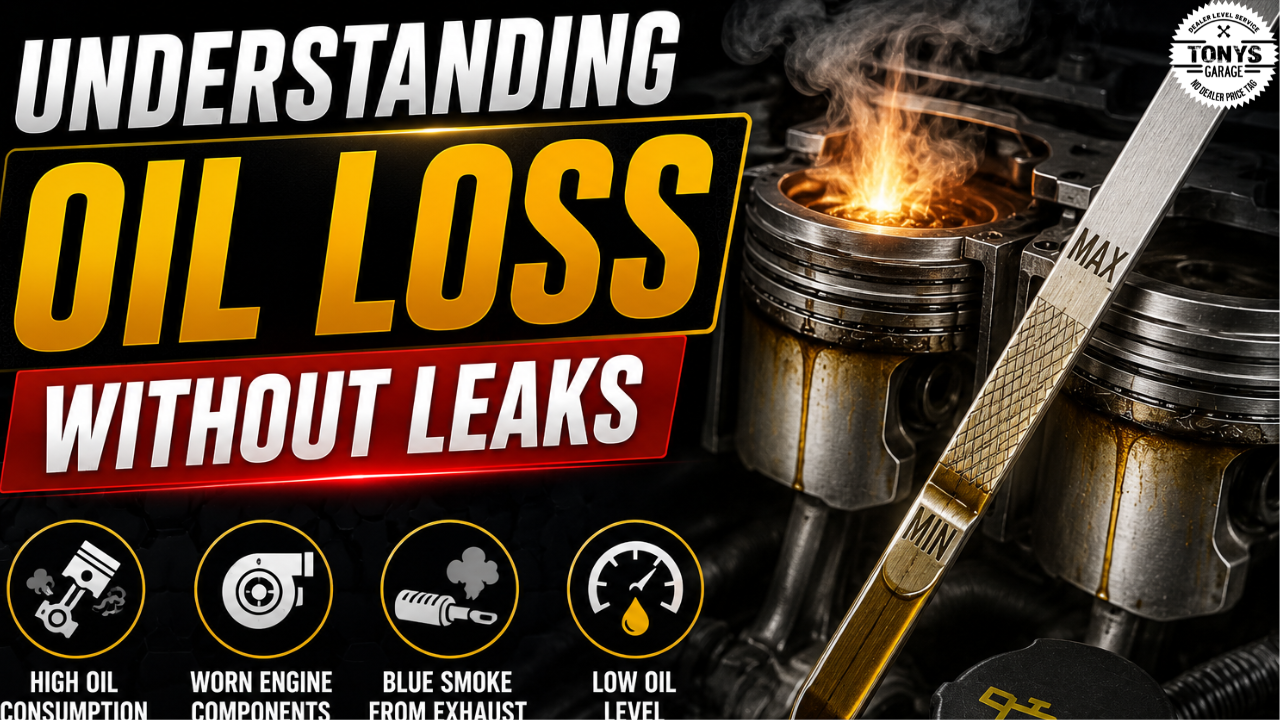
No Puddle. No Drip. But the Oil Just Keeps Disappearing.
I’ve had this conversation more times than I can count. Someone comes in, says their oil light flickered, or they noticed the level was low, and the first thing they say is “but there’s nothing on the ground.” Like that, it should mean everything is fine.
It doesn’t, unfortunately.
Oil can disappear without ever leaving a single drop on your driveway. And in my experience, that kind of oil loss is harder to catch because there’s no obvious clue staring at you in the face. You just keep adding oil and wondering why.
The Engine Can Burn It Right Under Your Nose
Here’s something a lot of people don’t know. Your engine can consume oil internally burn it right up during normal operation, and you’d have no idea unless you were watching it.
Sometimes you’ll see a little puff of bluish smoke from the exhaust, especially when you first start the car in the morning. Sometimes you won’t see anything at all. The oil just goes away, and the only sign is a dipstick reading that keeps coming low.
I always tell people if you’re adding oil between changes and there’s nothing leaking underneath; the engine is burning it somewhere. That’s not normal. That’s something we need to look at.
Worn Piston Rings Are Usually the First Thing We Check
Your pistons have rings around them. Their whole job is to keep oil out of the combustion chamber. When those rings wear down and they do wear down, especially on higher mileage engines, oil starts sneaking past them and getting burned up with the fuel.
Worn piston rings are one of the most common causes of this kind of oil loss. It’s quiet, it’s gradual, and a lot of folks don’t catch it until the engine’s been running low for a while. You might notice a little smoke on hard acceleration. Or you might notice nothing at all except a low oil level every couple of weeks.
Either way, this isn’t something to just keep topping off and ignoring. Running an engine low on oil wears things out fast.
Worn Valve Seals Do Something Pretty Similar
Your engine valves have seals on them. When those seals get old and worn, oil slowly seeps past them down into the combustion area and burns off. It’s a similar problem to the rings, just coming from a different part of the engine.
The thing that sometimes helps tell them apart, worn valve seals tend to cause more smoke right at startups. You’ll see a little blue puff when you first fire it up, and then it clears out once the engine warms up. With ring wear, the smoke shows up more under load or hard acceleration.
But honestly, don’t try to diagnose yourself based on smoke patterns. There’s overlap, there’s a nuance, and getting it wrong means doing the wrong repair. We have ways to test both properly.
Don’t Overlook the PCV Valve Small Part, Real Problem
Most people have never heard of a PCV valve. It stands for Positive Crankcase Ventilation, which I know sounds a lot, but the short version is; it manages pressure inside your engine.
When it goes bad, a faulty PCV valve can pull oil into the intake system where it gets burned off. It can also cause pressure to build up in the wrong places, which eventually pushes oil past seals that were otherwise fine. Either way, you end up with oil loss that’s hard to trace.
Here’s the part I like telling people. It’s one of the cheaper fixes on this list. A lot of times people come in bracing for bad news, and when it turns out to be the PCV valve, you can see the relief on their face. Catch it early and you’re in good shape.
Head Gasket Failure Is the One You Really Don’t Want to Ignore
I’m going to be straight with you on this one. Head gasket failure is serious. The gasket sits between the engine block and the cylinder head, and when it fails, oil can leak internally burning off inside the engine or mixing with the coolant.
Sometimes people notice a sweet smell from exhaust. Sometimes they see a milky, foamy buildup under the oil cap that’s oil and coolant mixing, which is never good. Sometimes the engine just runs hotter than it should have. And sometimes the only sign is oil loss that nobody can pin down any other way.
We’ve had engines come through here that could’ve been fixed without too much trouble if the owner had come in sooner. By the time they did, the damage had spread. I’m not trying to scare anyone I’m just telling you what I’ve seen over twenty-some years.
If the oil keeps dropping and nothing else explains it, please don’t wait.
Come In and Let’s Figure It Out Together
Look unexplained oil loss means something inside is telling you it needs attention. It might be something straightforward. It might be something bigger. But you’re not going to know sitting in your driveway checking the dipstick every few days.
We’ve been diagnosing this kind of thing at Tonys Garage for over two decades. All makes, all models. We’ll look at it right, tell you exactly what we find, and give you honest options. No pressure, no runaround, no guess.
And everything we do comes with a 24-month warranty, because I believe in standing behind the work, we send out the door.
Come see us before a manageable problem turns into something much worse. We’re right here.
Frequently Asked Questions
- How much oil loss is considered normal between oil changes?
A little consumption can be normal, especially on older engines or ones with a lot of miles on them. Using up to about a quart per thousand miles is within the acceptable range for some vehicles. But if you’re adding more than that, or if it’s a newer car and you’re adding oil at all, don’t just shrug it off. Come get it looked at. There’s usually a reason and finding it early is almost always better than waiting.
- Can I keep driving if my car is burning oil?
You can as long as you keep the level topped up and don’t let it run low. But I wouldn’t feel right telling you that’s a long-term solution. Whatever is causing the oil loss is still happening every time you drive. Worn rings, worn valve seals, a failing head gasket none of that gets better on its own. The engine keeps running; the wear keeps adding up, and eventually something gives. Get it diagnosed. That’s really the only responsible answer I can give you. - How do I know if it’s a head gasket failure versus something else?
Honestly, you probably can’t tell for sure on your own, and neither can we be without testing. The clues that point toward head gasket failure are things like milky oil, white or sweet-smelling exhaust smoke, coolant that keeps disappearing, or an engine that runs hotter than normal. But some of those symptoms can come from other problems too. We run a proper pressure test and combustion leak test to confirm it. It’s not something to guess at, especially given what’s involved in fixing it. - Will a faulty PCV valve always cause oil loss?
Not always, but it can, and it does more often than people expect. When the PCV valve isn’t working right, it messes the pressure balance inside the engine. Depending on how it fails, it can draw oil into places it shouldn’t be or push it past seals that were holding up fine before. Sometimes the main symptom is rough idling or a little more exhaust smoke. Other times it shows up as oil loss. It’s a small, inexpensive part if we find it failing during an inspection; we replace it. Simple as that. - Is it expensive to fix worn piston rings?
I’m not going to sugarcoat it; it’s a bigger job. Getting the rings means taking apart a significant portion of the engine, and the labor adds up. How much exactly depends on your vehicle’s make and model. What I will tell you is this: we’ll always give you a straight estimate and explain your options without pushing you toward anything. Sometimes the repair makes perfect sense. Sometimes, on a high-mileage vehicle, we have a different kind of conversation about what makes financial sense for you. Either way, you’ll get an honest picture from us.