
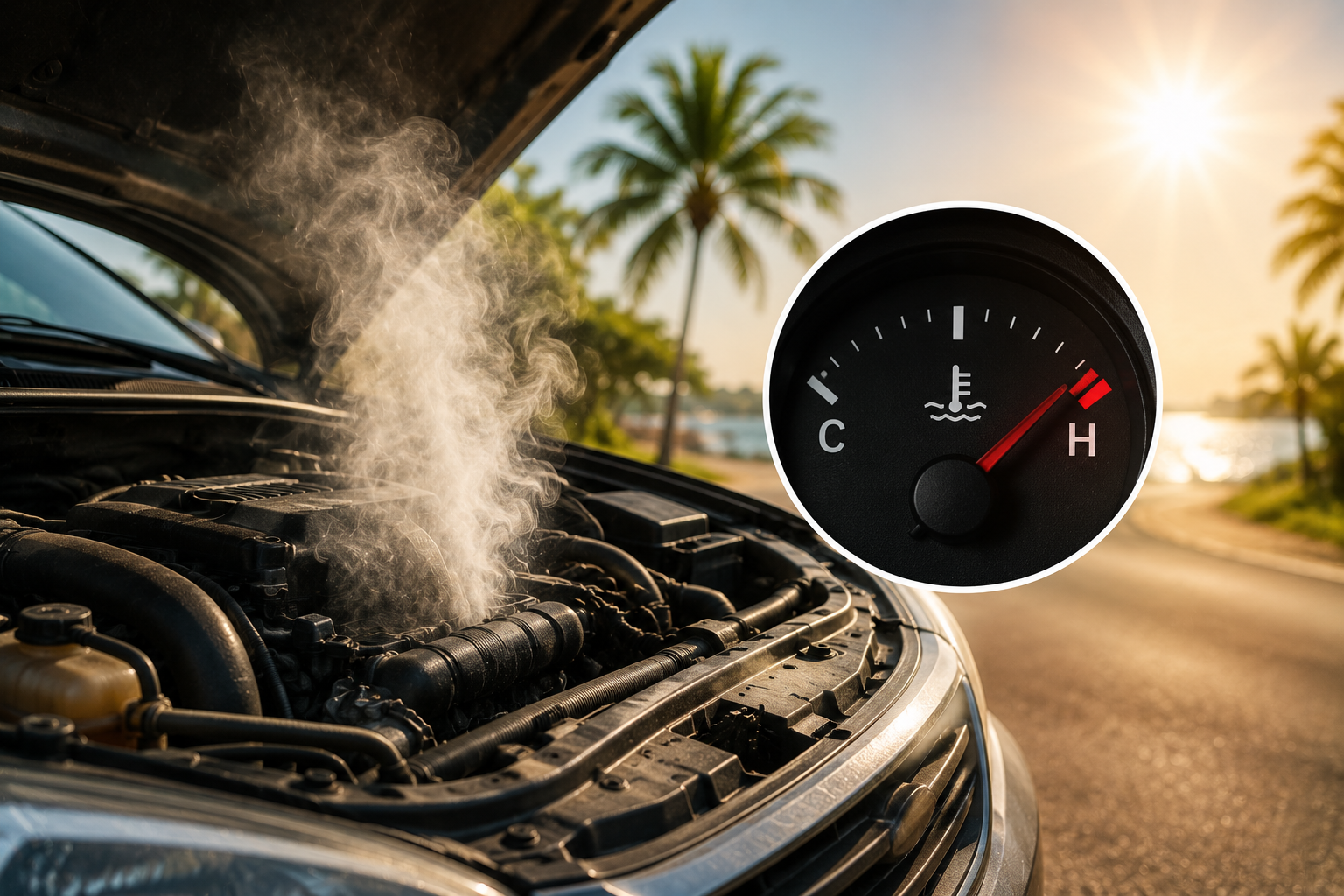
That Temperature Gauge Creeping into the Red Is Not Something to Ignore
You’re sitting in traffic on US-19 on a July afternoon. The AC is blasting. The sun is beating straight down on the hood. And then you glance at your dashboard and see that temperature gauge climbing slowly at first, then faster than you’d like. Car overheating in Florida in summer isn’t just an inconvenience. Left alone, it can destroy an engine in a matter of minutes.
Most people don’t know what to do when it happens. Pull over? Keep driving? Turn the heat on? It’s a stressful situation and the decisions you make in those first few minutes matter a lot.
Let’s talk about why it’s happening and what’s usually behind it.
Florida Heat Doesn’t Give Your Cooling System Any Grace Period
Here’s something worth understanding right from the start. Your engine generates enormous heat every time it runs. The cooling system’s entire job is to manage that heat and keep things in a safe operating range. In most climates, that’s a manageable task. In Florida, with ambient temperatures pushing 95 degrees and humidity making everything feel worse, that system is already working near its limits before anything goes wrong.
So, when even one part of that system starts to fail, a small leak, a weak pump, a clogged radiator, it doesn’t take long before car overheating becomes the result. There’s no buffer here the way there might be in cooler states. Issues that might be minor inconveniences up north can become real emergencies down here in peak summer.
That’s just the reality of driving in this climate. Worth knowing.
A Radiator Leak Is One of the Most Common Causes
Your radiator is what cools the hot coolant coming back from the engine before it cycles through again. When a radiator leak develops whether the radiator itself is cracked, a corroded tube, or a failed connection, coolant escapes and the system lose its ability to regulate temperature properly.
Sometimes a radiator leak is visible. You might notice a puddle under the front of the car, usually bright green, orange, or pink depending on the coolant type. Sometimes it’s slower and you only catch it when the coolant level drops enough to trigger an issue. Either way, a leak doesn’t fix itself. It gets worse with heat cycles and pressure.
We’ve seen people top off the coolant and drive another few weeks hoping for the best. That usually ends with a much bigger repair than they started with.
Low Coolant Level: Sometimes There’s No Leak at All
Not every cooling problem involves an obvious leak. Sometimes the coolant level just drops over time due to small amounts of evaporation or a minor internal issue, and nobody notices until the car’s overheating warning shows up.
The coolant reservoir is easy to check. It’s usually a translucent plastic tank near the radiator with MIN and MAX lines on the side. If it’s low, especially if it keeps coming back low after you top it off, that tells us something is going on. An internal leak, a failing head gasket, or a system that’s losing pressure somewhere.
Low coolant level is one of those things where a five-minute check could save someone a very expensive repair.
Water Pump Failure Stops Everything Cold
The water pump is the heart of your cooling system. It circulates coolant through the engine and back through the radiator continuously while the car is running. When water pump failure happens, that circulation stops. And without circulation, heat builds fast faster than most people expect.
Water pump failure doesn’t always announce itself loudly. Sometimes there’s a whining or grinding noise from the front of the engine. Sometimes coolant leaks from the weep hole on the pump itself. And sometimes the first sign is a temperature gauge that’s suddenly climbs with no other obvious explanation.
This is one we see fairly often, especially on higher-mileage vehicles and on cars where the timing belt drives the water pump. When those come in for timing belt service, we always recommend inspecting and often replacing the water pump at the same time, because the labor to get back there a second time is substantial.
A Bad or Stuck Thermostat Can Cause Big Problems Fast
The thermostat is a small valve that controls when coolant flows from the engine to the radiator. When the engine is cold, it stays closed so the engine can warm up quickly. Once the engine reaches normal operating temperature, it opens and lets coolant circulate through the radiator to shed heat.
When a thermostat stick closed which is the more dangerous failure coolant can’t flow to the radiator at all. Heat builds up inside the engine with nowhere to go, and car overheating follows quickly. It’s one of the fastest ways a cooling system can fail completely.
A thermostat that sticks open causes a different problem. The engine never fully warms up, which affects fuel economy, emissions, and how the heater works inside the car. Less dramatic than overheating, but still worth fixing.
The good news is that a thermostat is one of the more straightforward parts to replace. The bad news is that a lot of people don’t think about checking it because it’s such a small, inexpensive component. When we’re diagnosing an overheating complaint and the coolant level looks fine, the thermostat is one of the first things we test. A stuck one can mimic more expensive problems and catching it early keeps the repair bill where it belongs.
Cooling System Repair Is Worth Doing Right the First Time
The cooling system isn’t just the radiator and the water pump. It’s a network, hoses, the thermostat, the coolant itself, the pressure cap, the overflow tank, the fan, and the sensors that tell the car when to bring the fan on. Any one of those components failing can contribute to car overheating.
Cooling system repair done halfway tends to come back. We’ve had cars here where someone replaced the thermostat but ignored a weak hose, and three months later there’s a blowout on the side of the road. When we go into a cooling system, we look at the whole picture, not just the part that’s obviously failed.
It’s a more thorough approach, but it’s the reason our repairs are being held.
What to Do If Your Car Starts Overheating Right Now
Pull over safely as soon as you can. Turn off the AC and turn the heat on full, it sounds counterintuitive, but the heater core acts as a secondary radiator and can pull heat away from the engine in the short term. Don’t open the hood immediately. Don’t open the radiator cap when the engine is hot. Let it cool down fully before you check anything.
And then call us. Don’t try to nurse an overheating car across town. The damage that happens in those last few miles can be the most expensive part of the whole situation.
At Tonys Garage in New Port Richey, we diagnose cooling system problems the right way full inspection, not guesswork. All makes and models. Backed by our 24-month warranty. If your temperature gauge has been doing anything unusual, don’t wait for a full-blown car overheating emergency to find out why.
Frequently Asked Questions
- What should I do immediately if my car starts overheating?
Pull over as soon as it’s safe to do so don’t push through it hoping the gauge comes back down. Turn off the AC right away. Then, and this sounds strange, turn the heat on full blast. The heater core draws heat out of the coolant and can help lower engine temperature in a short-term pinch. Once you’ve stopped, do not open the hood while steam is visible and absolutely do not open the radiator cap. Wait until the engine has cooled completely at least 30 to 45 minutes before checking anything. Then call for help or get it towed. Driving an overheating car for even a few more miles can cause damage that turns a manageable repair into an engine replacement. - Can low coolant cause overheating even if there’s no visible leak?
Yes, and it happens more often than people think. Coolant can disappear slowly through a small internal leak, a failing head gasket that’s not yet showing obvious symptoms, or gradual evaporation over time in the Florida heat. If you check the reservoir and it’s consistently running low even after you top it off, that’s a signal that something is consuming or losing coolant somewhere in the system. It needs to be tracked down, not just refilled repeatedly. Persistent low coolant level is one of the clearest early warning signs that a bigger problem is developing. - Why does my car overheat in traffic but seem fine on the highway?
This is almost always a fan issue. When you’re moving at highway speeds, airflow through the grille naturally cools the radiator. Sitting still in traffic, the car depends entirely on the electric cooling fan to do that job. If that fan is failing running slowly, cycling on and off erratically, or not coming on at all, the radiator can’t shed heat fast enough and the temperature climbs. It’s a very recognizable symptom pattern and a straightforward diagnosis once we get the car on a scanner and watch how the fan behaves. - Can a bad AC system make the engine overheat?
It can contribute, yes. The AC condenser sits right in front of the radiator, and when it’s running, it adds heat to the air flowing through that area. If the cooling system is already marginal, low coolant, a weak fan, a slightly clogged radiator running the AC in Florida summer heat can push it over the edge. We’ve seen situations where a car overheating complaint turned out to be a combination of factors, with the AC being one piece of a larger puzzle. It’s worth mentioning to us if you notice the overheating happens primarily when the AC is on. - How much does a cooling system repair typically cost?
It depends entirely on what’s actually wrong. A bad or stuck thermostat replacement is one of the more affordable fixes. A water pump replacement is more involved, especially on engines where it’s driven by the timing belt. A radiator replacement falls somewhere in between depending on the vehicle. What I will tell you is that we’ll give you a full diagnosis before we quote anything, and you’ll know the complete cost before we start any work. No surprises at pickup. The other thing worth knowing about cooling system repairs caught early are almost always significantly cheaper than the same problem caught after the engine has already sustained heat damage. Don’t wait for this one.